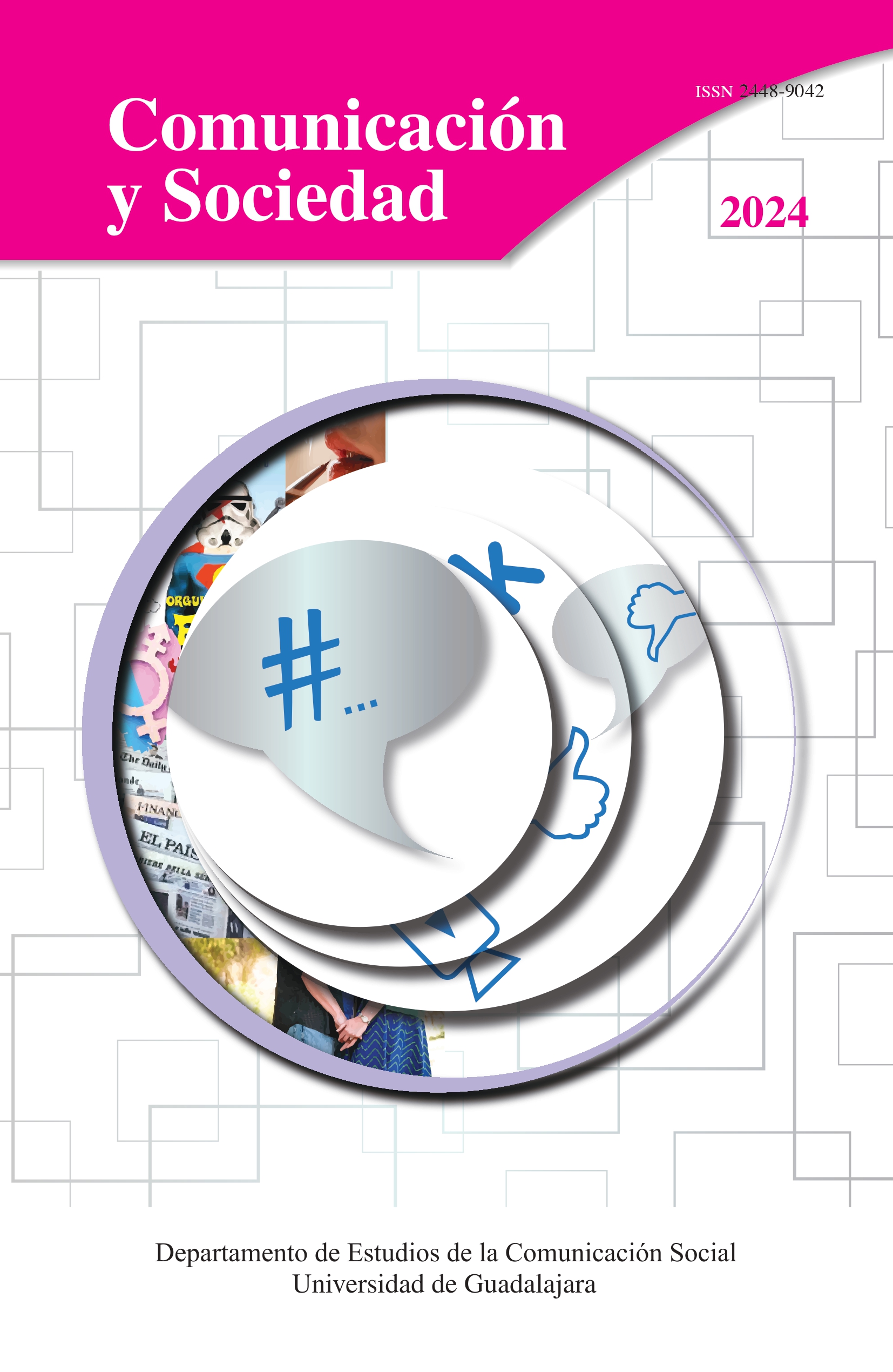
Expression of masculine identities on Facebook and TikTok: The case of De Machos a Hombres and Voices of Brotherhood
DOI:
https://doi.org/10.32870/cys.v2024.8627Keywords:
Facebook, Identity, Masculinities, Social media, TikTokAbstract
The central objective of this paper is to identify, through a content analysis, the way in which male identity traits are expressed in the publications of two Mexican profiles on Facebook and on TikTok. The main results show that, in the case of positive masculinities, this occurs mainly from statements about physical and mental self-care and participatory paternity. In the conclusions, it stands out that there is a need to propose new measurement scales of masculinities that adjust to changing cultural conditions.Downloads
References
Anderson, E. (2009). Inclusive Masculinity: The Changing Nature of Masculinities. Routledge.
Anderson, P. (2012). Measuring masculinity in an Afro-Caribbean context. Social and Economic Studies, 61(1), 49-93. https://www.jstor.org/stable/41803739
Arciniega, G. M., Anderson, T. C., Tovar-Blank, Z. G. & Tracey, T. J. (2008). Toward a fuller conception of Machismo: Development of a traditional Machismo and Caballerismo Scale. Journal of Counseling Psychology, 55(1), 19. https://doi.org/10.1037/0022-0167.55.1.19
Barker, G. (2000). Gender equitable boys in a gender inequitable world: Reflections from qualitative research and program development with young men in Rio de Janeiro, Brazil. Sexual and Relationship Therapy, 15(3), 263-82. https://doi.org/10.1080/14681990050109854
Bascán, A. (2007). Algunas consideraciones críticas sobre la aplicación de la metodología de género al estudio de las masculinidades. Revista Venezolana de Estudios de la Mujer, 12(28), 143-158.
Beyer, J. (2022). Knitting masculinities: How men are challenging masculinity and needlework in a post-pandemic age. Fashion, Style & Popular Culture, 10. https://doi.org/10.1386/fspc_00121_1
Boscán, A. S. (2006). Propuestas críticas para una concepción no tradicional de la masculinidad. Opción, 22(51), 26-49.
Boscán, A. S. (2008). Las nuevas masculinidades positivas. Utopía y Praxis Latinoamericana, 13(41), 93-106. https://philpapers.org/rec/LEALNM
Briseño, M. L. (2011). La construcción de la sexualidad y el género en estudiantes de la Escuela Normal Bilingüe e Intercultural de Oaxaca (enbio) [Tesis de Doctorado]. Universidad Nacional Autónoma de México. http://132.248.9.195/ptd2012/enero/0676160/0676160_A1.pdf
Butler, J. (2011). Gender trouble: Feminism and the subversion of identity. Routledge.
Carabí, À. (2000). Construyendo nuevas masculinidades: una introducción. En M. Segarra & Á. Carabí (Eds.), Nuevas masculinidades (pp. 15-28). Icaria.
Chu, J. Y., Porche, M. V. & Tolman, D. L. (2005). The adolescent masculinity ideology in relationships scale: Development and validation of a new measure for boys. Men and Masculinities, 8(1), 93-115. https://doi.org/10.1177/1097184X03257453
Connell, R. W. (1987). Gender and Power. Society, the Person and Sexual Politics. Polity Press, Blackwell.
Connell, R.W. (1995). Masculinities. University of California Press.
Cruzalegui, G. F. (2021). Masculinidad y violencia de género en universitarios de la región de Lima [Tesis de Licenciatura]. Universidad César Vallejo. https://hdl.handle.net/20.500.12692/90015
De Dauw, E. & Connell, D. J. (Eds.). (2020). Toxic Masculinity: Mapping the Monstrous in Our Heroes. University Press of Mississippi.
Doss, B. D. & Hopkins, J. R. (1998). The multicultural masculinity ideology scale: Validation from three cultural perspectives. Sex Roles, 38(9), 719-741. https://doi.org/10.1023/A:1018816929544
Dyer, S. (2018). Masculinities, Wallpaper, and Crafting Domestic Space within the University, 1795–1914. Nineteenth Century Gender Studies, 14.2. https://uhra.herts.ac.uk/bitstream/handle/2299/22514/dyer.pdf
Elliott, K. (2016). Caring masculinities: Theorizing an emerging concept. Men and Masculinities, 19(3), 240-259. https://doi.org/10.1177/1097184X15576203
Espinar-Ruiz, E. & Ocampo, I. (2017). La representación de masculinidades en las páginas web de citas. Un análisis cualitativo. Prisma, 18, 561-570. http://revistaprismasocial.es/article/view/1422
Flood, M., Gardiner, J. K., Pease, B. & Pringle, K. (2007). International Encyclopedia of Men and Masculinities. Routledge.
Foster, J. & Baker, J. (2022). Muscles, makeup, and femboys: Analyzing TikTok’s “radical” masculinities. Social Media + Society, 8(3). https://doi.org/10.1177/20563051221126040
Fraguas, R. (2000). Por una masculinidad positiva. Razón y Fe, 242(1222-1221), 99-104. https://revistas.comillas.edu/index.php/razonyfe/article/view/19222
Fuller, N. (2018). Difícil ser hombre: Nuevas masculinidades latinoamericanas. Fondo Editorial de la pucp.
García, L. F. (2015). Nuevas masculinidades: discursos y prácticas de resistencia al patriarcado [Tesis de Maestría]. flacso Ecuador.
García-Gómez, A. (2020). Discursive representation of masculinity and femininity in Tinder and Grindr: Hegemonic masculinity, feminine devaluation and femmephobia. Discourse & Society, 31(4), 390-410. https://doi.org/10.1177/0957926520903523
Godfrey, S. (2021). Masculinity in British Cinema, 1990-2010. Edinburgh University Press.
Gore, A. (2001). Making student men at the University of Zimbabwe: politics, masculinity and democracy. En R. B. Gaidzanwa (Ed.), Speaking for ourself: masculinities and femininities amongst students at the University of Zimbabwe (pp. 29-48). UZ Publications.
Gough, B. & Novikova, I. (2020). Mental health, men and culture: how do sociocultural constructions of masculinities relate to men’s mental health help-seeking behaviour in the who European Region? World Health Organization.
Gutmann, M. C. (2000). Ser hombre de verdad en la ciudad de México: ni macho ni mandilón. El Colegio de México.
Gutmann, M. C. & Viveros, M. (2005). Masculinities in Latin America. En M. S. Kimmel, J. Hearn & R. W. Connell (Eds.), Handbook of studies on men and masculinites (pp. 114-128). sage.
Harrington, C. (2021). What is “toxic masculinity” and why does it matter? Men and Masculinities, 24(2), 345-352. https://doi.org/10.1177/1097184X20943254
Haywood, C. & Mac an Ghaill, M. (2012). ‘What's next for masculinity?’ Reflexive directions for theory and research on masculinity and education. Gender and Education, 24(6), 577-592. https://doi.org/10.1080/09540253.2012.685701
Hunt, P. (1986). What Would Daddy Have Done? Overt and Covert Constructions of Masculinity in Twentieth Century Children's Literature. Kunapipi, 8(1). https://ro.uow.edu.au/kunapipi/vol8/iss1/22/
Hytti, U., Karhunen, P. & Radu-Lefebvre, M. (2023). Entrepreneurial Masculinity: A Fatherhood Perspective. Entrepreneurship Theory and Practice, 1-28. https://doi.org/10.1177/10422587231155863
Janey, B. A., Kim, T., Jampolskaja, T., Khuda, A., Larionov, A., Maksimenko, A., Sharapov, D & Shipilova, A. (2013). Development of the Russian Male Norms Inventory. Psychology of Men & Masculinity, 14(2), 138. https://doi.org/10.1037/a0028159
Kiselica, M. S. & Englar-Carlson, M. (2010). Identifying, affirming, and building upon male strengths: The positive psychology/ positive masculinity model of psychotherapy with boys and men. Psychotherapy. Theory, Research, Practice, Training, 47(3), 276-287. https://doi.org/10.1037/a0021159
Kimmel, M. S. (1998). From ‘Conscience and Common Sense’ to ‘Feminism for Men: Profeminist Men’s Rhetorics of Support for Women’s Equality. En S. P. Schacht & D. W. Ewing (Eds.), Feminism and Men: Reconstructing Gender Relations (pp. 21–42). New York University Press.
Kimmel, M. S. (2010). Misframing men: The politics of contemporary masculinities. Rutgers University Press.
Krippendorff, K. (1990). Metodología de análisis de contenido. Teoría y práctica. Paidós.
Lackey, R. (2021). Men Playing Together: New Masculinities, Sport, and Contemporary Fiction. En L. R. Cooper (Ed.), The Routledge Companion to Masculinity in American Literature and Culture (pp. 220-236). Routledge.
Lagarde, M. (2005). Los cautiverios de las mujeres. Madresposas, monjas, putas, presas y locas. unam.
Lerner, G. (1986). La Creación del Patriarcado. Crítica.
Luyt, R. (2005). The male attitude norms inventory-II: A measure of masculinity ideology in South Africa. Men and Masculinities, 8(2), 208-229. https://doi.org/10.1177/1097184X04264631
MacInnes, J. (1994). Men in the Public Eye. Sociology, 28(1), 342-344.
Malti-Douglas, F. (2007). Encyclopedia of Sex and Gender. MacMillan.
Marshall, K., Chamberlain, K. & Hodgetts, D. (2020). Male bodybuilders on Instagram: Negotiating inclusive masculinities through hegemonic masculine bodies. Journal of Gender Studies, 29(5), 570-589. https://doi.org/10.1080/09589236.2020.1722620
Martín, A. (2022). Not Into Bad Guys Anyways: Scott McCall, or Positive Representations of Masculine Identities in US Supernatural Teen Drama [Tesis de pregrado]. Universitat de les Illes Balears. https://dspace.uib.es/xmlui/handle/11201/161283
Martínez-Valerio, L. (2023). Mensajes misóginos en los perfiles de TikTok de la prensa española: estudio y percepción por parte de los jóvenes. Ámbitos: Revista Internacional de Comunicación, 59, 110-127. https://doi.org/10.12795/Ambitos.2023.i59.08
McGeeney, E. & Harvey, L. (2015). Cisgender. Living in the Gender Assigned at Birth. En C. Richards & M. G. Barker (Eds.), The Palgrave Handbook of Psychology of Sexuality and Gender (pp. 149-165). Palgrave.
McLean, R. & Schubert, R. (1995). Queers and the Internet. Media International Australia, 78(1), 48-52. https://doi.org/10.1177/1329878X9507800108
Messerschmidt, J. W & Messner, M. A. (2018). Hegemonic, nonhegemonic and "new" masculinities. En J. W. Messerschmidt, P. Y. Martin, M. A. Messner & R. Connell (Eds.), Gender reckonings. New Social Theory and Research (pp. 35-56). New York University Press.
Mirandé, A. (2018). Hombres y machos: Masculinity and Latino culture. Routledge.
Monaghan, L. F. (2005). Big handsome men, bears and others: Virtual constructions of ‘fat male embodiment’. Body & Society, 11(2), 81-111. https://doi.org/10.1177/1357034X05052463
Morrell, R. (1998) The new man? Agenda: Empowering women for gender equity, 14(37), 7-12. https://www.tandfonline.com/doi/abs/10.1080/10130950.1998.9675683
Mustonen, V. (2020). Men and masculinities in Nordic cinema and its American remakes: A comparative analysis [Tesis de maestría]. University of Jyväskylä. https://jyx.jyu.fi/handle/123456789/71632
Nagoshi, J. L. & Nagoshi, C. T. (2013). Gender and sexual identity: Transcending feminist and queer theory. Springer.
Ocampo, I. G. (2015). Un acercamiento a las identidades masculinas desde las online dating [Tesis de licenciatura]. Universidad de Alicante. http://hdl.handle.net/10045/47991
Ojeda, A., Melby, L., Sánchez, V. & Rodarte de Lara, M. (2007). Correlación entre rasgos de masculinidad-feminidad y satisfacción marital en migrantes mexicanos. Migración y Desarrollo, 8, 48-65.
Pascoe, C. J. & Diefendorf, S. (2019). No homo: Gendered dimensions of homophobic epithets online. Sex roles, 80(3-4), 123-136. https://doi.org/10.1007/s11199-018-0926-4
Paulson, S. & Boose, M. (2019). Masculinities and environment. cabi Reviews, 14(030), 1-12. https://doi.org/10.1079/PAVSNNR201914030
Pedraza, C. (2019). Cibermisoginia en las redes sociodigitales: claves para el análisis desde la masculinidad. Cuestiones de género: de la igualdad y la diferencia, 14, 51-66. https://doi.org/10.18002/cg.v0i14.5814
Pérez, G. (2021). Identidad y virtualidad. Aproximaciones desde la Comunicación. Tintable.
Pulerwitz, J. & Barker, G. (2008). Measuring attitudes toward gender norms among young men in Brazil: development and psychometric evaluation of the gem scale. Men and Masculinities, 10(3), 322-338. https://doi.org/10.1177/1097184X06298778
Ray, C. (1998). Let’s hear it for the boys! Health Education, 98(1), 8-14.
Rivera, A. & Scholar, J. (2020). Traditional masculinity: a review of toxicity rooted in social norms and gender socialization. Advances in Nursing Science, 43(1), E1-E10. https://doi.org/10.1097/ANS.0000000000000284
Rojas, O. F. & Morales, A. (2020). Machismo. En B. J. Carducci, C. S. Nave, J. S. Mio & R. E. Riggio (Eds.), The Wiley Encyclopedia of Personality and Individual Differences: Clinical, Applied, and Cross‐Cultural Research (pp. 243-246). Wiley. https://doi.org/10.1002/9781119547181.ch305
Salvati, M., Passarelli, M., Chiorri, C., Baiocco, R. & Giacomantonio, M. (2021). Masculinity threat and implicit associations with feminine gay men: Sexual orientation, sexual stigma, and traditional masculinity. Psychology of Men & Masculinities, 22(4), 649. https://psycnet.apa.org/doi/10.1037/men0000338
Salam, R. (2021). Men will be Men?: Masculinities on display in the Facebook communication practices of Pakistani men. Norma, 16(1), 38-56. https://doi.org/10.1080/18902138.2021.1875640
Sartre, J. P. (2002). El ser y la nada. Ensayo de ontología fenomenológica. Iberoamericana.
Scheibling, C. (2020). “Real heroes care”: How dad bloggers are reconstructing fatherhood and masculinities. Men and Masculinities, 23(1), 3-19. https://doi.org/10.1177/1097184X18816506
Segal, E. S. (2004). Cultural Constructions of Gender. En C. R. Ember & M. Ember, (Eds.), Encyclopedia of Sex and Gender Men and Women in the World's Cultures (pp. 3-23). Kluwer Academic, Plenum Publishers.
Segrest, S. L., Romero, E. J. & Domke‐Damonte, D. J. (2003). Exploring the role of machismo in gender discrimination: A comparison of Mexico and the US. Equal Opportunities International, 22(1), 13-31. https://doi.org/10.1108/02610150310787298
Statista. (2022). El meteórico ascenso de TikTok. https://es.statista.com/grafico/28454/numero-de-usuarios-activos-de-redes-sociales-seleccionadas-a-nivel-mundial/
Strier, R. & Perez‐Vaisvidovsky, N. (2021). Intersectionality and fatherhood: theorizing non‐hegemonic fatherhoods. Journal of Family Theory & Review, 13(3), 334-346. https://doi.org/10.1111/jftr.12412
Trott, V. A. (2022). ‘Gillette: The best a beta can get’: Networking hegemonic masculinity in the digital sphere. New Media & Society, 24(6), 1417-1434. https://doi.org/10.1177/1461444820978293
Underwood, M. & Olson, R. (2019). ‘Manly tears exploded from my eyes, lets feel together brahs’: Emotion and masculinity within an online body building community. Journal of Sociology, 55(1), 90-107. https://doi.org/10.1177/1440783318766610
Vásquez, M. A. (2020). Plan de comunicación digital para el proyecto: campaña educomunicativa multimedia sobre la construcción social de masculinidades para la erradicación de la violencia y discriminación de género [Tesis de Licenciatura]. Universidad Politécnica Salesiana Ecuador. http://dspace.ups.edu.ec/handle/123456789/17652
Venäläinen, S. & Virkki, T. (2019). Struggles for moral value and the reproduction of gendered and racialised hierarchies in online discussions of violence. The Sociological Review, 67(6), 1367-1382. https://doi.org/10.1177/0038026119866635
Versiani, J. C. (2022). “The claws of feminism”: anti-feminist hate speech on Facebook and the sense of controlled urgency. Intercom: Revista Brasileira de Ciências da Comunicação, 45. https://doi.org/10.1590/1809-58442022119en
White, M. (2019). Producing masculinity: The internet, gender, and sexuality. Routledge.
Wilson, M. J. (2022). Cultivating positive masculinity is mental health promotion for boys and men. Health Promotion International, 37(4), 1-2. https://doi.org/10.1093/heapro/daac121
Wilson, M., Gwyther, K., Swann, R., Casey, K., Featherston, R., Oliffe, J. L., Matt Englar-Carlson, M. & Rice, S. M. (2022). Operationalizing positive masculinity: a theoretical synthesis and school-based framework to engage boys and young men. Health Promotion International, 37(1), https://doi.org/10.1093/heapro/daab031
Wong, Y. J., Horn, A. J., Gomory, A. M. & Ramos, E. (2013). Measure of Men’s Perceived Inexpressiveness Norms (M2PIN): Scale development and psychometric properties. Psychology of Men & Masculinity, 14(3), 288. https://doi.org/10.1037/a0029244
Published
How to Cite
Issue
Section
License

This work is licensed under a Creative Commons Attribution-NonCommercial 4.0 International License.
The authors who publish in this journal accept the following conditions:
In accordance with copyright laws, the authors retain the authorship rights and grant Comunicación y Sociedad the right of first public communication of the work. Comunicación y Sociedad does not charge the authors for submitting and processing articles for publication.
The authors can enter into independent and additional contractual agreements for the nonexclusive distribution of the version of the article published in Comunicación y Sociedad (for example include it into an institutional repository or publish it in a book) as long as it is clearly indicated that the work was published for the first time in Comunicación y Sociedad.